
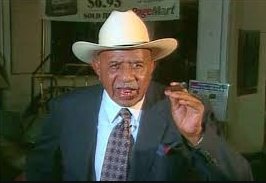
"Bad credit? No credit? No problem! Go see the Special Man. Let her have it!"
If you grew up watching television in New Orleans anytime from the 1980s through the 2000s, those words are burned into your brain. You can hear the voice. You can see the cowboy hat. You can picture the cigar. The Frankie and Johnny's Furniture commercials were cheap, chaotic, and absolutely unforgettable — and they turned a small furniture store on St. Claude Avenue into one of the most iconic pieces of New Orleans pop culture.
The Store
Frankie and Johnny's Furniture was a modest operation at 2600 St. Claude Avenue, in the heart of the Bywater-St. Claude corridor. It was not a fancy place. It was not trying to be a fancy place. The store sold furniture to working-class New Orleanians — bedroom sets, living room suites, dining tables — on easy credit terms that didn't require a pristine financial history. In a city where plenty of people lived paycheck to paycheck, that mattered.
Frank Trapani owned and operated the store for over 40 years. Trapani was a businessman who understood his market: people who needed furniture and couldn't get credit at the big chains. He built his business on accessibility, and he built his brand on the most improbable advertising campaign in New Orleans television history.
The Commercials
The Frankie and Johnny's commercials were the creation of advertising executive Rod Montz, and they were unlike anything else on television. The format was simple and never varied: Frank Trapani would shuffle down the narrow aisle of his store, reciting the pitch in his thick New Orleans accent. The message was straightforward — if you had bad credit, no credit, were on Social Security, on welfare, or had been turned down everywhere else, Frankie and Johnny's would still sell you furniture.
But the star of the commercials wasn't Trapani. It was the Special Man.
The Special Man
The Special Man was the closer. After Trapani laid out the pitch — listing every possible financial hardship a customer might face — he'd turn to a figure sitting in the back of the store, wearing an oversized cowboy hat, a suit, and holding a fat cigar. This was the Special Man, the mysterious authority figure who had the power to approve any deal, no matter how unlikely.
"Let her have it," the Special Man would drawl, and the deal was done. No credit check could survive the Special Man's approval. No financial obstacle was too great. The Special Man said yes when everybody else said no, and he did it with the calm authority of a man who has never been troubled by doubt.
The original Special Man was Lester Love Sr., a salesman at the store who brought an effortless cool to the role. Love didn't overplay it. He sat there in his hat, with his cigar, and delivered his line like a man who had all the time in the world and not a worry to show for it. It was a performance of magnificent understatement, and it made the commercials work. Love played the Special Man until his death in 2001.
After Love's passing, Emile Washington took over the role, bringing his own style to the cowboy hat and cigar while maintaining the character's essential cool. Washington continued as the Special Man until his death in 2007. Both men became beloved figures in New Orleans, recognized on the street and celebrated as local celebrities — all from a low-budget furniture commercial.
Why They Worked
On paper, the Frankie and Johnny's commercials should not have worked. They were low-budget. The production values were minimal. The same basic script was repeated over and over again. There were no special effects, no jingles (well, sort of), no celebrities. By every standard of professional advertising, they were terrible.
And yet they were perfect. The commercials worked because they were authentic. Frank Trapani was a real furniture store owner talking to real people about real problems. The Special Man was a real salesman sitting in a real store. Nothing was polished or pretend. In a city that values authenticity above almost everything else, that rawness was the secret ingredient.
The commercials also worked because they were funny — intentionally or not, depending on who you ask. The deadpan delivery, the repetitive format, the escalating list of financial calamities that were all "no problem" — it had a comedic rhythm that got funnier with repetition rather than staler. Kids would memorize the commercials and perform them for each other. Adults would quote them at parties. The Special Man's "Let her have it" became a citywide catchphrase.
Going Viral Before Viral Was a Thing
The Frankie and Johnny's commercials were a viral sensation decades before the internet made that concept possible. They spread through the city by word of mouth, imitation, and sheer repetition on local television. Every New Orleanian of a certain generation could recite the commercials from memory, and doing so was a reliable way to establish your local credentials.
When the internet did arrive, the commercials found a whole new audience. Videos of the spots circulated widely online, introduced to people who had never been to New Orleans and couldn't believe what they were seeing. In 2011, Conan O'Brien aired the commercial on his late-night show and launched a parody contest for viewers, bringing the Special Man to a national audience that was equal parts amused and bewildered.
RuPaul, who grew up in New Orleans, has publicly paid tribute to the commercials as a touchstone of his childhood. The New Orleans Pelicans created a homage commercial featuring Anthony Davis as the Special Man. The spots transcended advertising and became cultural artifacts — proof that New Orleans could make something unforgettable out of absolutely nothing except personality.
The End of an Era
Frank Trapani retired and eventually moved to Port St. Lucie, Florida, where he died in 2012 at the age of 83. The store on St. Claude Avenue closed, and the building sat as another piece of the neighborhood's evolving landscape. The property changed hands, and in 2025, the Krewe du Vieux — one of New Orleans' most irreverent Mardi Gras organizations — purchased the building, which feels like exactly the right kind of afterlife for a place that was always more about spectacle than commerce.
The Legacy
Frankie and Johnny's Furniture is gone, but the Special Man lives forever. The commercials remain some of the most beloved and quoted pieces of New Orleans pop culture — right up there with Popeyes commercials, Rosenberg's ads, and the other local TV spots that made New Orleans television a world unto itself.
What the Special Man represented was something deeper than a furniture pitch. He represented the idea that somebody was on your side — that no matter how broke you were, no matter how many doors had been slammed in your face, there was a guy in a cowboy hat on St. Claude Avenue who would look at your situation and say, "No problem. Let her have it." In a city full of people who have been told no by banks, insurance companies, and the government, that message resonated in ways that went far beyond bedroom sets.
Bad credit? No credit? Doesn't matter. The Special Man already approved you. He always did.
Frequently Asked Questions
Who was the Special Man?
The original Special Man was Lester Love Sr., a salesman at Frankie and Johnny's Furniture who appeared in the store's television commercials wearing a cowboy hat and holding a cigar. Love played the role until his death in 2001 and was succeeded by Emile Washington, who continued until his death in 2007.
Where was Frankie and Johnny's Furniture located?
The store was located at 2600 St. Claude Avenue in New Orleans. Frank Trapani owned and operated the store for over 40 years. The building was purchased by Krewe du Vieux in 2025.
Who created the Frankie and Johnny's commercials?
The commercials were conceived by advertising executive Rod Montz. They featured store owner Frank Trapani walking the aisles delivering the pitch, with the Special Man providing the approval catchphrase.
What happened to Frank Trapani?
Frank Trapani retired from the furniture business after running the store for over 40 years. He moved to Port St. Lucie, Florida, where he died on July 19, 2012, at the age of 83.
Were the commercials shown nationally?
The commercials were local New Orleans television spots, but they gained national exposure when Conan O'Brien featured them on his late-night show in 2011. The Pelicans also created an homage featuring Anthony Davis. RuPaul has cited the commercials as a memorable part of growing up in New Orleans.



2 comments
Lisa
I would, literally, rehearse this commercial in the mirror when I was a kid. I never knew Saturday morning commercials would be so memorable. I can not wait for this shirt to come back in stock with my size.
Stan
Your not in Kansas, the Upper 9.
YA herd me
Leave a comment
All comments are moderated before being published.
This site is protected by hCaptcha and the hCaptcha Privacy Policy and Terms of Service apply.